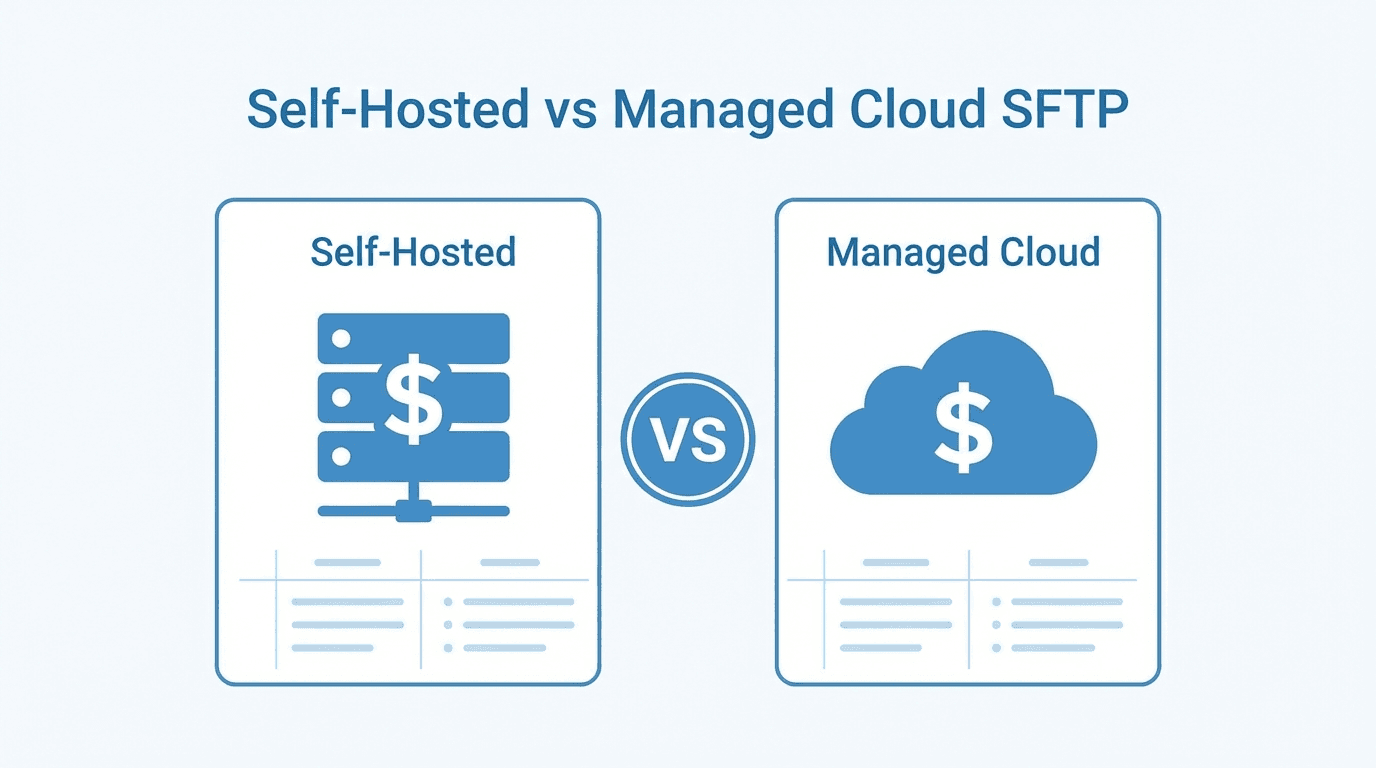
Choosing between a self-hosted SFTP server and a managed cloud SFTP service is not just a technical decision. It is a financial one. This guide breaks down the costs on both sides, highlights the hidden expenses that are easy to overlook, and helps you determine which approach makes the most sense for your organization.
Self-hosted SFTP costs
Running your own SFTP server means owning the full stack, from hardware to software to the people who keep it running.
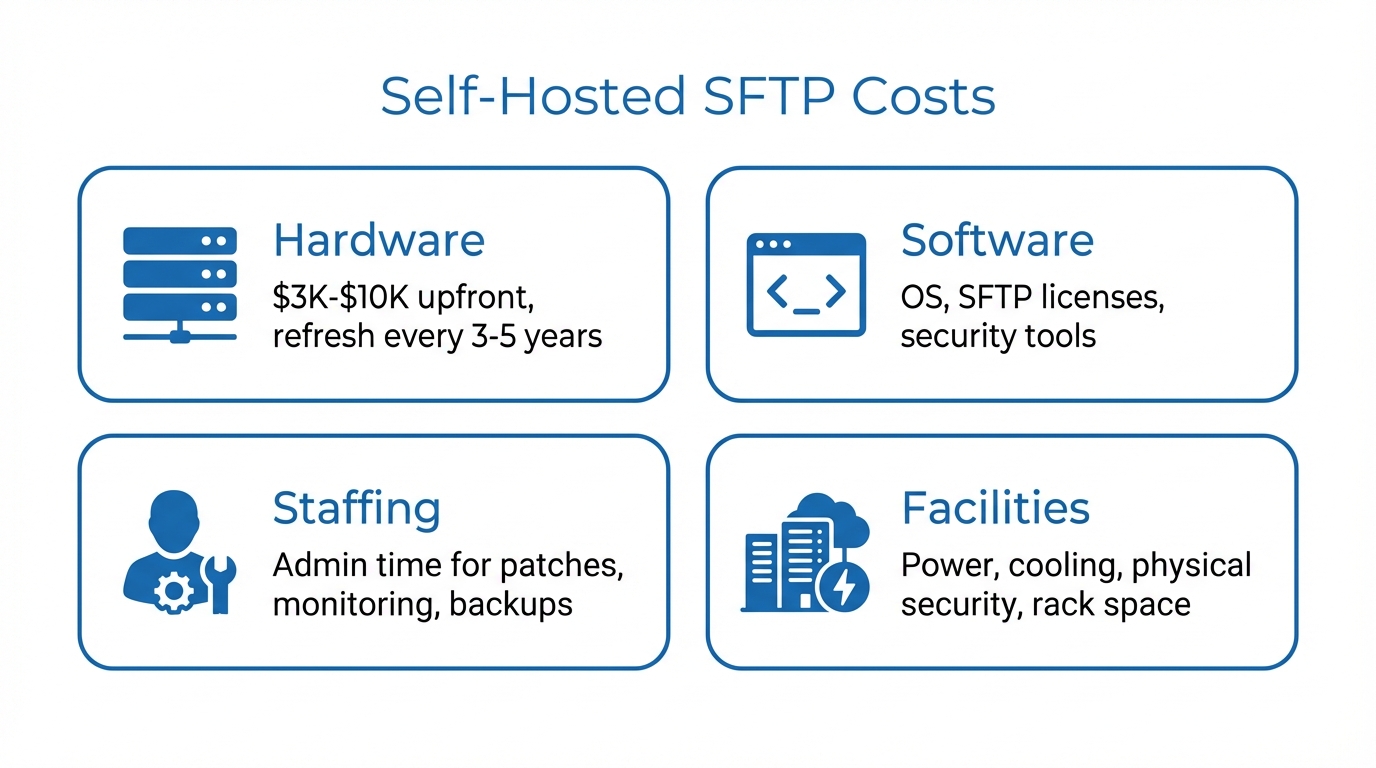
Hardware
- Servers - A production-grade server with redundancy typically costs between $3,000 and $10,000 upfront, depending on specifications. Plan for a hardware refresh every three to five years.
- Storage - Enterprise-grade storage arrays or NAS devices add another significant line item. Costs scale with the volume of data you need to store and retain.
- Networking - Firewalls, switches, load balancers, and redundant internet connections are necessary for a reliable setup.
Software
- Operating system and SFTP software - While OpenSSH is free, many organizations use commercial SFTP server software for better management features, costing anywhere from a few hundred to several thousand dollars per year in licensing.
- Security tools - Antivirus, intrusion detection, log management, and certificate management tools all carry their own licensing fees.
Staffing
This is often the largest cost. You need system administrators who can:
- Install, configure, and maintain the SFTP server.
- Apply security patches and operating system updates promptly.
- Monitor for outages, performance issues, and security incidents.
- Manage user accounts, SSH keys, and access controls.
- Handle backups, disaster recovery testing, and capacity planning.
Even a part-time allocation of a system administrator's time represents tens of thousands of dollars per year.
Facility costs
If you are hosting on-premise rather than in a colocation facility, factor in power, cooling, physical security, and rack space.
Managed cloud SFTP costs
With a managed service, you pay a recurring subscription that bundles infrastructure, maintenance, and support into a single fee.
Subscription fees
Managed SFTP providers typically charge based on a combination of:
- Number of users - How many internal and external accounts you need.
- Storage volume - How much data is stored on the platform.
- Transfer bandwidth - Some providers meter data transfer, while others include it in the subscription.
Monthly costs range from tens of dollars for small teams to hundreds or thousands for larger deployments.
Storage and bandwidth
Most providers include a baseline allocation of storage and bandwidth. Overages are billed at published rates. Understanding your transfer patterns helps you choose a plan that avoids surprise charges.
Hidden costs on both sides
Self-hosted hidden costs
- Downtime - Unplanned outages cost money in lost productivity and missed SLAs. Without redundancy, a single hardware failure can take your server offline.
- Compliance audits - Preparing for and passing security audits requires staff time, documentation, and sometimes third-party assessors.
- Opportunity cost - Time your team spends managing SFTP infrastructure is time not spent on projects that drive business value.
- Scaling costs - When you outgrow your current hardware, upgrades require capital expenditure and project planning.
Managed cloud hidden costs
- Egress fees - Some cloud providers charge for outbound data transfer, which can add up for high-volume workflows.
- Add-on features - Advanced features like custom branding, additional compliance certifications, or premium support tiers may cost extra.
- Migration costs - Moving to (or away from) a managed provider involves time and effort for setup, testing, and user migration.
Total cost of ownership comparison
For a small team transferring moderate volumes of data, a managed cloud SFTP service is typically more cost-effective. The subscription fee is predictable, and the operational burden is minimal.
For larger organizations with existing infrastructure teams and complex customization requirements, self-hosted may appear cheaper on paper. However, when you account for staffing, hardware refreshes, downtime, and compliance overhead, the total cost of ownership often exceeds what a managed service would cost.
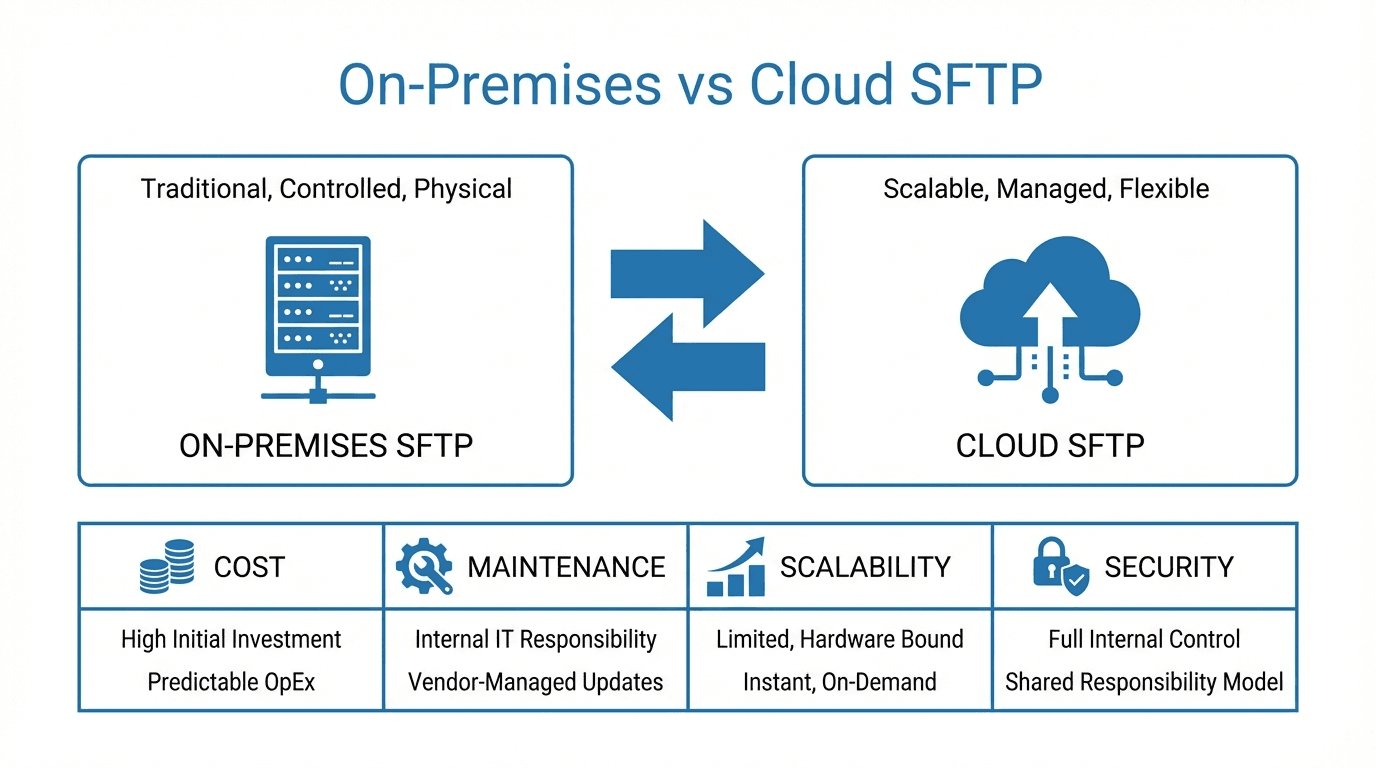
| Factor | Self-hosted | Managed cloud | |---|---|---| | Upfront investment | High (hardware, software) | Low (subscription) | | Ongoing staffing | Required (admin, security) | Minimal (configuration only) | | Scaling | Manual, capital-intensive | Automatic, usage-based | | Security maintenance | Your responsibility | Provider's responsibility | | Predictability | Variable | Predictable monthly cost |
Security and compliance considerations
Both options can meet stringent security requirements, but the path is different.
With self-hosted, you have full control over every aspect of your security configuration. This flexibility comes with the responsibility of keeping everything up to date and correctly configured.
With a managed service, the provider handles infrastructure security, patching, and often holds compliance certifications (SOC 2, ISO 27001, GDPR) that you can inherit. This can simplify your own audit process significantly.
Scalability
Self-hosted servers have a fixed capacity. Scaling up requires purchasing and provisioning new hardware, which takes time and budget approval.
Managed cloud services scale on demand. If your transfer volume doubles next month, the platform handles it without any infrastructure changes on your end.
When to choose which
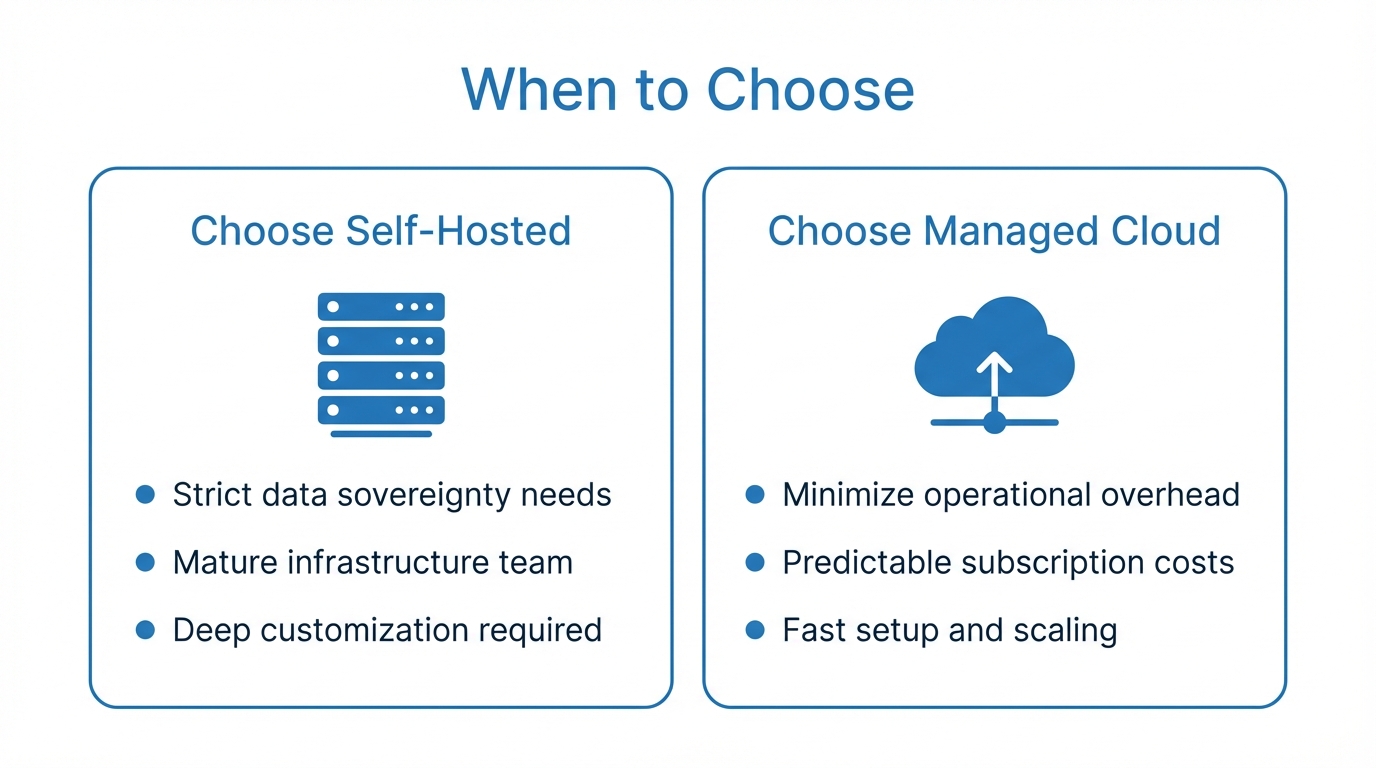
Self-hosted is a better fit when:
- You have strict data sovereignty requirements that prevent using third-party infrastructure.
- Your organization already has a mature infrastructure team and existing datacenter capacity.
- You need deep customization that managed providers do not support.
Managed cloud is a better fit when:
- You want to minimize operational overhead and focus your team on core business activities.
- You need predictable, subscription-based costs.
- You are scaling and do not want infrastructure to become a bottleneck.
- You need to be up and running quickly without a lengthy procurement and setup process.
Making the decision
The right choice depends on your organization's size, technical resources, compliance needs, and growth trajectory. For most teams, a managed cloud SFTP service offers the best balance of cost, reliability, and simplicity.
Want to see the managed approach in action? Start a free trial of FilePulse or talk to our team to walk through your requirements.