When multiple clients, partners, or departments share a single SFTP server, keeping their data separate is essential. Multi-tenancy in SFTP means serving multiple independent users or organizations from the same infrastructure while ensuring that no tenant can access another tenant's files. Getting this wrong can lead to data breaches, compliance violations, and broken trust.
What Multi-Tenancy Means for SFTP
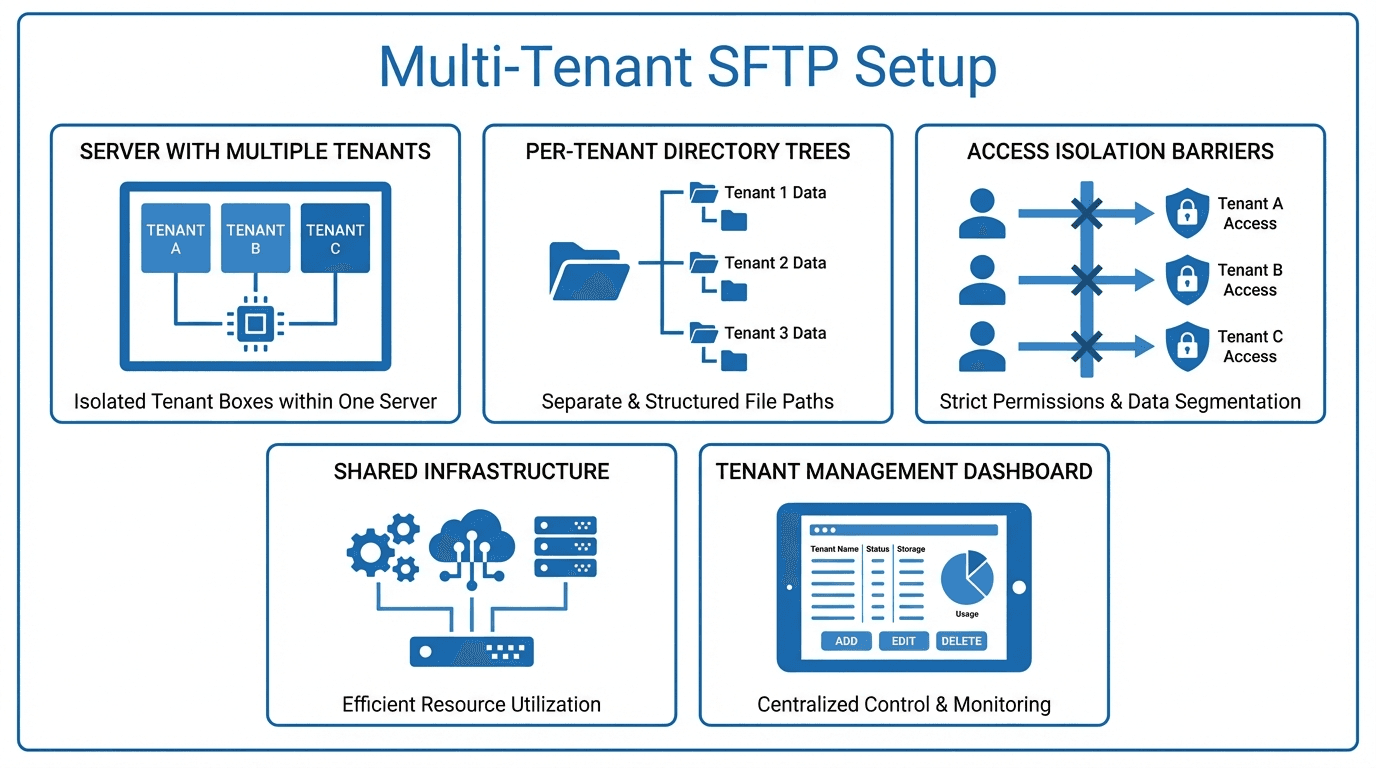
In a multi-tenant SFTP setup, each tenant (a client, partner, or business unit) gets:
- Their own login credentials (username, SSH keys, or both)
- An isolated file space that they cannot escape
- Independent access controls governing what they can read, write, or delete
- Separate audit trails tracking their activity
The challenge is implementing this isolation reliably, especially as tenant counts grow.
Tenant Isolation Requirements
Proper tenant isolation involves several layers:
- Filesystem isolation: Tenants must not be able to navigate outside their designated directory. They should not see other tenants' files, directory names, or even know that other tenants exist.
- Process isolation: One tenant's activity (large uploads, many concurrent connections) should not degrade performance for others.
- Network isolation: Where possible, restrict connections by source IP address so tenants can only connect from known networks.
- Credential isolation: Each tenant should have unique credentials. Shared credentials across tenants defeat the purpose of isolation.
Common Approaches to Isolation
Chroot Jails
The most traditional approach is chroot, which confines a user to a specific directory tree. After authentication, the user's root directory is set to their home folder, and they cannot traverse above it.
Pros: Simple to configure on most SSH/SFTP servers. Well understood and widely supported.
Cons: Requires careful OS-level configuration. File permissions must be set precisely, or users may escape the jail. Does not provide storage-level isolation (all tenants share the same disk).
Virtual Filesystem Mapping
A virtual filesystem abstracts the underlying storage from the SFTP directory structure. Each user sees a customized directory tree that maps to different storage locations behind the scenes.
Pros: Flexible mapping of directories to different storage backends. Supports per-user or per-directory storage targets. No reliance on OS-level file permissions for isolation.
Cons: Requires an SFTP server that supports virtual filesystem features. More complex initial setup.
Separate Servers
Running a dedicated SFTP server per tenant provides the strongest isolation but at the highest cost. Each tenant gets their own server instance, IP address, and storage.
Pros: Complete isolation with no shared resources. Simplifies compliance for high-security tenants.
Cons: Expensive and operationally heavy. Does not scale well beyond a handful of tenants. Management overhead grows linearly with tenant count.
How FilePulse Handles Multi-Tenancy
FilePulse is built for multi-tenant file transfer from the ground up. Here is how it addresses isolation:
Virtual Directories
Each user in FilePulse is assigned a virtual directory structure that maps to their specific storage location. Users see only their own files and folders, with no visibility into other tenants' data. The virtual filesystem layer handles all path resolution, so there is no risk of directory traversal attacks.
Per-User Storage Mapping
With FilePulse's BYOS model, each tenant can be mapped to a different storage backend or bucket. One tenant's files can go to an S3 bucket in eu-west-1, while another tenant's files go to an Azure Blob container in eastus. This provides both logical and physical data separation.
IP Restrictions
FilePulse supports per-user IP allowlists, so you can restrict each tenant to connect only from their known IP addresses or ranges. This adds a network-level isolation layer on top of credential-based access control.
Audit Logging
Every file operation is logged per user, including uploads, downloads, deletions, and directory listings. These logs can be filtered by tenant for compliance reporting or incident investigation.
Use Cases for Multi-Tenant SFTP
Managed Service Providers (MSPs)
MSPs that handle file transfers for multiple clients need strict isolation between client environments. Multi-tenant SFTP lets them serve all clients from a single platform without cross-contamination.
B2B Data Exchange Platforms
Companies that exchange files with dozens or hundreds of business partners need each partner to have their own isolated file space, credentials, and access policies.
Internal Departmental Isolation
Large organizations sometimes need to separate file transfer workflows by department (finance, HR, operations) to enforce data access policies and maintain clean audit trails.
Need multi-tenant SFTP without the infrastructure headaches? Start your free trial of FilePulse and onboard your first tenants in minutes. Have questions about isolation or compliance? Contact us.