Legacy FTP servers are everywhere. They have been running for years, sometimes decades, quietly moving files between systems and partners. On the surface, they seem cheap to operate: the software is free, the server is already provisioned, and the workflows are established. But this surface-level simplicity masks significant hidden costs that accumulate over time.
If your organization is still relying on legacy FTP, it is worth understanding what you are really paying.
The Visible Costs
The obvious costs of running an FTP server are modest:
- Server infrastructure. A VM or physical server to run the FTP daemon.
- Storage. Disk space for staging files during transfer.
- Bandwidth. Network costs for data in transit.
- Basic administration. Time spent creating user accounts and managing credentials.
These costs are easy to quantify, which is why legacy FTP often survives budget reviews. But they represent only a fraction of the true cost.
The Hidden Costs
Security Exposure
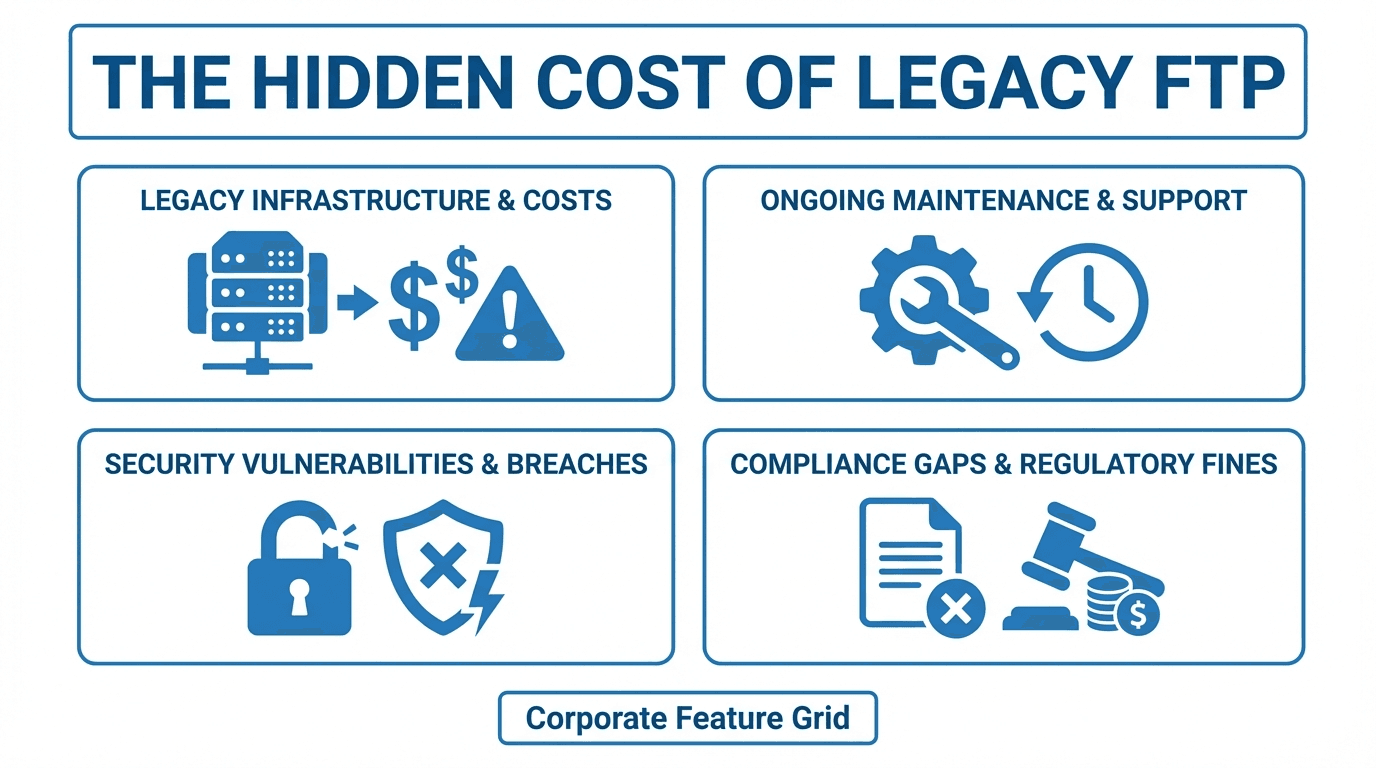
Standard FTP transmits credentials and data in plaintext. Anyone with access to the network path between your server and your partners can intercept usernames, passwords, and file contents. Even if you have upgraded to FTPS (FTP over TLS), the configuration is notoriously finicky. Misconfigured certificates, fallback to unencrypted connections, and passive mode firewall issues are common problems.
The cost of a security breach stemming from an insecure file transfer can dwarf years of FTP operational costs. Data breach notification expenses, regulatory fines, legal fees, and reputational damage add up quickly.
Compliance Liability
Regulations like GDPR, HIPAA, PCI DSS, and SOX require organizations to protect sensitive data during transmission. Legacy FTP, with its lack of encryption and minimal logging, fails to meet these requirements.
The compliance cost is not just the risk of fines. It is the ongoing burden of explaining to auditors why your file transfer infrastructure does not meet modern security standards. Organizations often spend significant time and money on compensating controls and audit responses to justify their continued use of FTP.
Operational Fragility
Legacy FTP servers are often single points of failure. They run on aging hardware, use outdated software versions, and lack redundancy. When they go down, file transfers stop, and the business processes that depend on them grind to a halt.
The operational cost includes:
- Unplanned downtime while the server is repaired or replaced
- Manual recovery of interrupted transfers
- On-call burden for the team responsible for keeping the server running
- Lack of monitoring that delays detection of failures
Shadow IT
When the official FTP server is unreliable or difficult to use, teams find workarounds. They set up their own FTP servers, use personal file sharing services, or email files as attachments. This shadow IT creates security blind spots and makes it impossible to maintain a complete audit trail of file movements.
The cost of shadow IT extends beyond security risk. It fragments institutional knowledge, creates duplicate workflows, and makes it harder to enforce consistent policies.
Integration Friction
Legacy FTP servers typically lack APIs, webhooks, and event-driven capabilities. Integrating them with modern systems, such as cloud storage, data pipelines, monitoring tools, and workflow automation platforms, requires custom scripting and ongoing maintenance.
Every integration built on top of a legacy FTP server is fragile. Changes to the FTP server configuration, directory structure, or naming conventions can break downstream systems. The engineering time spent building and maintaining these integrations is a significant hidden cost.
Talent Drain
Maintaining legacy FTP infrastructure is not rewarding work for engineers. It involves troubleshooting obscure protocol issues, managing user accounts manually, and responding to partner complaints about connectivity problems. Over time, this work contributes to engineer burnout and turnover.
The cost of replacing experienced engineers, and the knowledge that leaves with them, is substantial. Legacy systems that are "owned" by a single person create dangerous knowledge silos.
How Managed File Transfer Addresses These Costs
A modern managed file transfer (MFT) platform eliminates most of these hidden costs:
Security. MFT platforms use SFTP, HTTPS, and other encrypted protocols by default. There is no option to fall back to unencrypted connections. Key management, certificate rotation, and access controls are built in.
Compliance. Comprehensive audit logging, encryption at rest and in transit, and role-based access controls satisfy the requirements of most regulatory frameworks. Audit preparation becomes a matter of exporting logs rather than assembling evidence from multiple sources.
Reliability. Managed platforms handle infrastructure, redundancy, patching, and monitoring. You do not need to worry about server failures or outdated software versions.
Centralization. A single platform for all file transfers eliminates shadow IT and provides complete visibility into file movements across your organization.
Integration. Modern MFT platforms provide APIs, webhooks, and native integrations with cloud storage and workflow tools. Connecting to your existing stack is straightforward rather than requiring custom scripts.
Developer experience. Your engineering team focuses on building valuable features instead of maintaining legacy infrastructure.
The ROI Argument
When you add up the hidden costs, the total cost of ownership for legacy FTP is often several times higher than the sticker price of a managed solution. Consider:
- What would a data breach cost your organization?
- How much engineering time is spent maintaining FTP servers and custom integrations?
- How many hours per month does your team spend on partner onboarding and troubleshooting?
- What is the cost of compliance audit findings related to insecure file transfers?
For most organizations, the answer makes the ROI of switching to MFT clear.
Migration Guidance
Moving away from legacy FTP does not have to be a disruptive, all-at-once project. A phased approach works well:
- Inventory your FTP workflows. Document every server, every partner connection, and every automated script that depends on FTP.
- Prioritize by risk. Start with workflows that handle sensitive data or serve critical business processes.
- Set up your MFT platform. Connect your storage backends and configure the basics.
- Migrate partners incrementally. Move one partner or workflow at a time, running both systems in parallel during the transition.
- Decommission FTP servers once all workflows have been migrated and verified.
FilePulse makes this migration straightforward with multi-protocol support, easy partner onboarding, and storage integrations that work with your existing infrastructure.
Start your free trial of FilePulse to begin your migration from legacy FTP, or contact our team for help planning your transition.